How Lateral Acceleration Is Detected by Onboard Sensors
Every telematics programme, whether it runs through a plug-in device, a factory-installed module, or a smartphone app, relies on a small accelerometer to sense motion in three dimensions. Forward and backward motion registers as acceleration and braking. Up-and-down motion mostly gets filtered out as road noise. The dimension that matters for cornering is lateral acceleration — the sideways force that pushes a vehicle’s contents toward the outside of a turn.
When a car turns, the tires generate a centripetal force that keeps the vehicle on its curved path. The accelerometer inside the phone or device measures the reaction to that force, typically expressed in units of g (a fraction of standard gravity). A gentle highway curve taken at speed might produce a lateral reading of a few hundredths of a g. A tight, fast turn can push that figure well above a tenth of a g, and aggressive slaloming or a sharp evasive swerve can spike higher still.
Phone-based systems face an added complication: the phone’s orientation inside the car isn’t fixed. Software has to work out which axis of the sensor corresponds to “sideways” relative to the vehicle, a process usually done by watching how the readings behave over the first several minutes of a trip and recalibrating continuously. Dashboard-mounted devices and factory telematics units, which are bolted to the car in a known orientation, generally produce cleaner and more consistent lateral readings than a phone sitting loose in a cupholder or bag. This is one reason two drivers in the same car, one using a phone app and one using a plug-in dongle, can occasionally see somewhat different cornering scores for what felt like the same driving.
GPS data is layered on top of the raw accelerometer signal. Speed and position let the algorithm distinguish a real turn from, say, the phone shifting position on a seat, and they also let it estimate the radius of the turn being taken — information that matters for the next step: deciding which turns are worth flagging.
The Difference Between a Sharp Turn and a Flagged Cornering Event
Not every corner that produces a noticeable lateral force gets logged as an event that affects a score. Insurers set a threshold — a lateral acceleration value that a turn must exceed before it’s recorded — and that threshold is calibrated against ordinary driving so that routine cornering, like turning into a parking lot or following a curved exit ramp at a reasonable speed, doesn’t trigger a flag every few minutes.
Most programmes combine two things before logging an event:
- A lateral force threshold, so only turns above a certain sharpness are candidates.
- A duration or repetition check, so a single brief blip caused by sensor noise or a pothole doesn’t count the same as a sustained hard turn.
Speed at the point of the turn matters too, because the same steering angle produces very different lateral forces depending on how fast the car is going. A tight turn taken slowly may never cross the threshold, while a much gentler curve taken too fast can. This is part of why the algorithm is measuring force rather than steering angle directly — force is a better proxy for how much stress the turn actually put on the vehicle and its occupants, and by extension how much margin for error the driver had left themselves.
Once a turn crosses the threshold, it’s typically logged as a discrete event with a timestamp, location, speed, and severity value. Some systems bucket these into tiers — for instance, a moderate cornering event versus a harsh one — with harsher events carrying a larger scoring penalty. The exact thresholds, tiering, and weighting are proprietary to each insurer’s programme and are rarely published in detail, so a driver comparing notes with a friend on a different insurer’s app should expect the numbers to not line up neatly even if the driving looked similar from the outside.
How Road Design and Unavoidable Turns Get Treated by the Algorithm
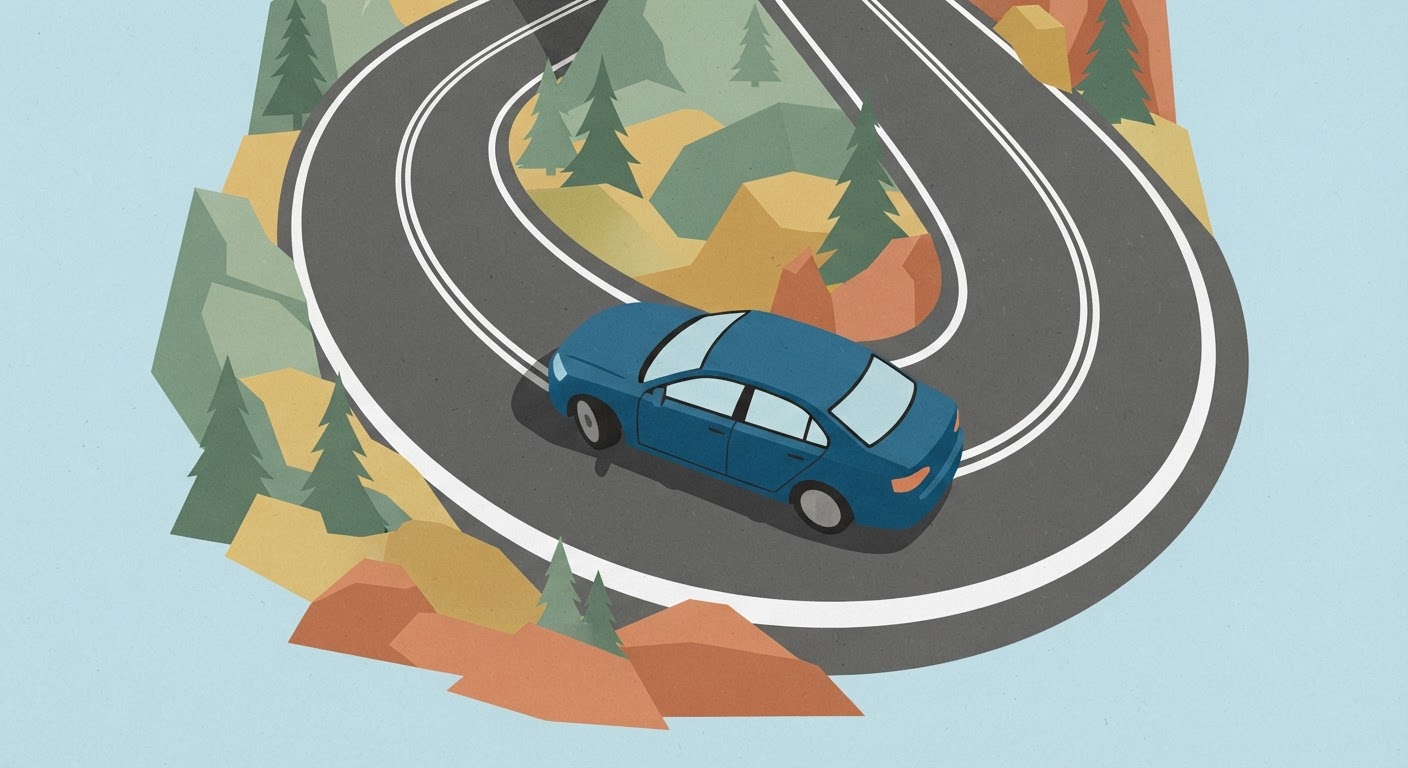
One of the more persistent frustrations drivers report with cornering scores is the sense of being penalized for the road itself rather than for how they drove it. A cloverleaf highway interchange, a mountain switchback, or a tightly curved neighborhood street can require lateral forces that would look identical to careless driving on a straight road, even when the driver is doing exactly what the road demands.
Telematics providers are aware of this and most have some form of map-matching built in, using GPS position data to compare the recorded route against known road geometry. In principle, this lets the algorithm distinguish “sharp turn because the road curves sharply here” from “sharp turn because the driver cut a gentle curve too fast.” In practice, how well this works varies a great deal by provider, by how current and detailed the underlying map data is, and by how strong the GPS signal was at that moment — dense urban blocks, tunnels, and multi-level interchanges are all places where GPS accuracy tends to degrade.
Where map-matching is weak or absent, the practical effect is that a driver whose regular commute includes a lot of curved roads, on-ramps, or roundabouts may see a persistently lower cornering score than a driver on a mostly straight commute, independent of how carefully either one is driving. This is a known limitation rather than a hidden one, but it’s not always disclosed clearly to the driver in the app itself, and it’s worth checking a specific programme’s materials or asking the insurer directly whether road-geometry adjustment is applied to cornering events before assuming a low score reflects driving behavior alone.
A related wrinkle involves necessary evasive maneuvers — swerving to avoid an object, an animal, or another vehicle’s sudden movement. A single sharp lateral event of this kind will typically still be logged and scored the same as any other hard corner, because the sensor has no way to know intent. Some programmes allow a small number of these events to be absorbed without much effect on an overall score simply because the scoring is usually based on a rate of events per mile or per trip rather than a strict count, so an isolated incident in months of otherwise smooth driving tends to have limited weight. A pattern of frequent hard cornering, by contrast, is much harder for the algorithm to explain away as one-off necessity, and will read as a consistent behavioral signal.
Why Cornering Scores Tend to Vary More Than Braking Scores
Drivers who watch their own telematics dashboards over time often notice that their braking score settles into a fairly stable number, while their cornering score moves around more from week to week or month to month. There are a few structural reasons this tends to happen.
First, braking events are largely a function of the driver’s following distance and reaction time, which are relatively stable habits that don’t change much depending on where someone happens to drive. Cornering events, by contrast, are heavily shaped by the specific roads travelled on a given trip. A week of driving confined to a grid of straight suburban streets will generate very few cornering opportunities at all; a week that includes a mountain drive, an unfamiliar city with tight one-way streets, or a highway interchange with a tight cloverleaf will generate several, almost regardless of skill. Route variability feeds directly into score variability in a way that braking is less exposed to.
Second, the detection threshold for lateral force is sensitive to small changes in vehicle speed and steering input near the margin, more so than the threshold for deceleration tends to be in ordinary traffic. A turn taken at just above versus just below the flagged speed can be the difference between a logged event and nothing at all, and ordinary variation in traffic conditions — needing to slow slightly more or less for a curve depending on the car ahead — can push a turn across that line on one trip and not the next.
Third, sensor placement and calibration issues described earlier affect lateral readings more than they affect forward/backward readings, because gravity provides a constant, easily-corrected reference for the vertical and forward axes, while the sideways axis depends more on how well the device’s orientation has been estimated. A phone that shifts slightly in a cupholder mid-trip can introduce noise into lateral readings that wouldn’t show up the same way in braking data.
None of this means cornering scores are meaningless or that they should be dismissed — used correctly, they can capture a real pattern of taking turns faster or more sharply than the road warrants. But because the score is more exposed to route, road geometry, and sensor-placement noise than braking is, most usage-based programmes treat it as one input among several rather than the dominant factor in an overall driving score, and it’s the input most likely to look “noisy” to a driver checking their app week to week. If a cornering score seems consistently out of step with a driver’s own sense of how they drive, the more informative comparison is usually not one week against another, but the pattern over several months against the mix of roads actually travelled — and, where an insurer publishes it, whether route-based adjustment is factored into that particular metric before it’s rolled into a discount or surcharge.