Two Different Sensors, Two Different Stories
When an insurer says it uses “telematics” to score your driving, that phrase can mean two quite different pieces of hardware doing the measuring. One is a small plug-in device that clips into a port under your dashboard and talks directly to the car’s onboard computer. The other is an app installed on your phone that uses the motion sensors already inside the handset. Both are trying to answer similar questions – how hard did you brake, how fast were you going, did you use the phone while driving – but they get to those answers through completely different physical processes. Understanding the mechanism matters because it explains why the same trip can sometimes look different depending on which method recorded it.
How a Plug-In Device Reads the Car Itself
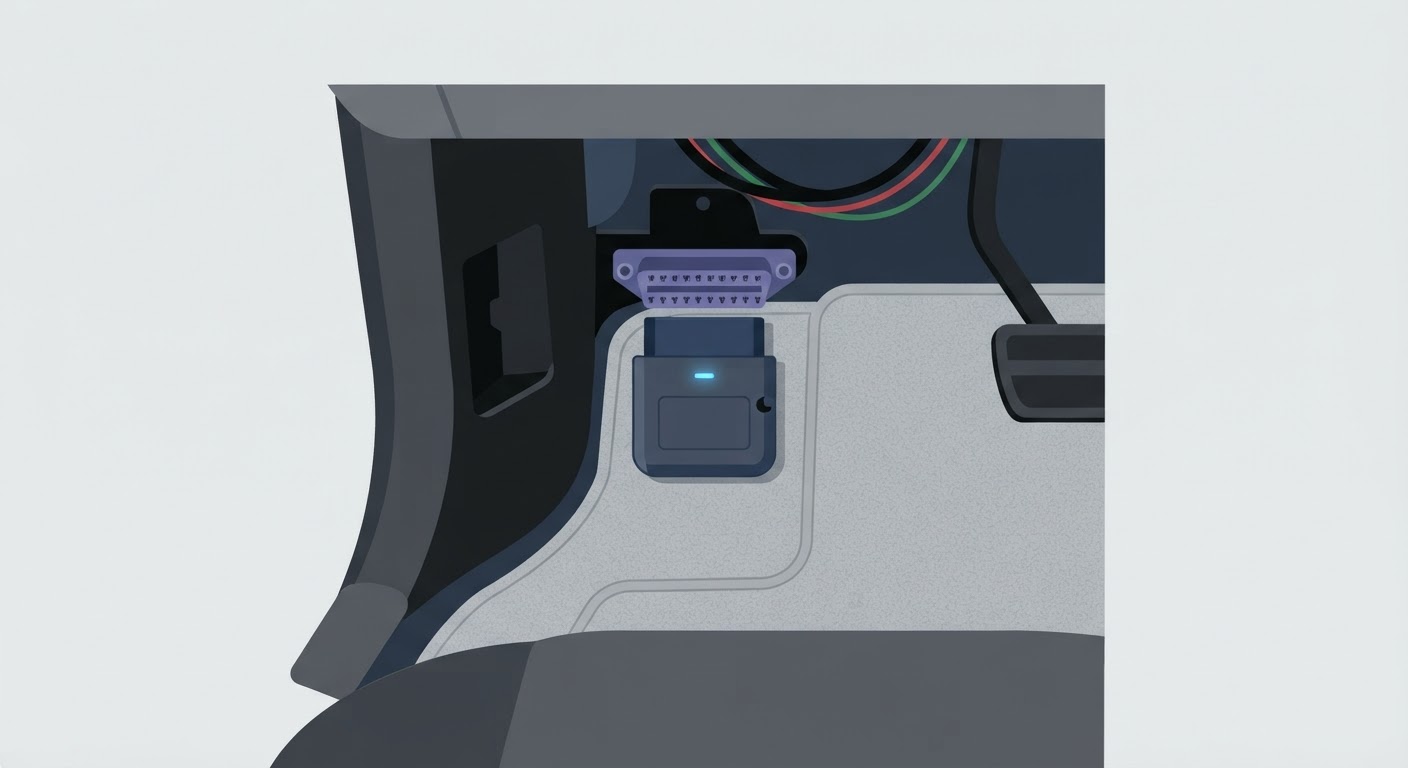
Most modern vehicles sold in the US have a standardized diagnostic port, commonly referred to by its interface name, OBD-II, located near the driver’s footwell. This port was originally built for mechanics and emissions testing, but it also exposes a stream of data that the car’s own computer is already generating: engine RPM, throttle position, wheel speed, brake activation, and often airbag or crash-sensor status. An insurer-issued plug-in tracker connects to this port and simply listens to that existing data stream.
Because the device is reading signals the vehicle’s own systems produce for its own operation, the numbers tend to be close to what the engineering team designing that car intended them to represent. Speed readings come from the transmission or wheel-speed sensors rather than from an outside estimate. Hard-braking events are usually flagged from the same sensor that operates the brake lights, and sudden deceleration or airbag deployment can sometimes be detected directly rather than inferred. The device then stores this information locally for a period and transmits it, usually over a built-in cellular connection, back to the insurer’s system on a set schedule.
The main physical limitation is fitment and connection quality. Older vehicles may have a different port shape or a diagnostic protocol the device does not fully support, which can produce gaps in the data rather than errors within it. A loose-fitting connector, a port shared with an aftermarket remote starter, or a port that’s simply hard to reach can also cause intermittent disconnection. When the device is unplugged – deliberately or not – it typically cannot record anything at all for that period, and some programmes flag prolonged disconnection as a scoring event in itself.
How a Phone App Infers the Same Data
A smartphone app has no direct line to the car’s computer. Instead, it relies on sensors built into the phone itself, principally the accelerometer, which measures changes in motion along three axes, and the GPS receiver, which estimates location and, from successive location fixes, speed. Some apps also draw on the phone’s gyroscope for orientation and its network connection for cell-tower or Wi-Fi positioning when GPS signal is weak, such as in a parking garage or dense downtown corridor.
From this raw motion data, the app has to infer things the plug-in device would simply read off the car. Braking is not sensed directly – it is estimated from a deceleration pattern that looks like braking rather than, say, the driver picking up the phone off a seat. Speed is calculated from position changes over time rather than pulled from the vehicle’s speedometer signal, which introduces a small delay and some rounding. Whether the phone is even in a moving vehicle, as opposed to a bus, a bike, or a passenger’s hand, is itself something the software has to estimate from the shape of the motion signal, sometimes with help from Bluetooth pairing to the car’s audio system as a corroborating signal.
This inference step is the core difference from the plug-in approach, and it is also where most of the app-based method’s known weak points originate. Phone placement changes the accelerometer reading: a phone lying flat on a seat records different vibrations than one in a cupholder, a pocket, or a mount. A driver who is a passenger rather than the one driving can be misclassified, particularly on shared trips like carpools or rideshare pickups. Battery-saving settings on some phones can reduce how frequently the sensors are sampled, thinning out the data the app has to work with. None of this means the app is unreliable in a blanket sense – many are built with correction models specifically to handle these cases – but it does mean the app is solving a harder inference problem than the plug-in device, which is mostly just relaying numbers the car has already computed.
Where Each Method Tends to Be More Reliable
Neither approach is uniformly better; each tends to be stronger in areas that match its underlying mechanism.
- Speed and braking precision. A plug-in device usually has an edge here because it reads figures the vehicle’s own sensors generate, rather than deriving them from position changes or acceleration patterns.
- Driver identification within a shared vehicle. This is genuinely difficult for both methods, but a plug-in device tied to a specific vehicle at least confirms which car was moving, even if it can’t always confirm who was behind the wheel. An app tied to a phone can confirm whose phone was present, but not necessarily who was driving if the phone was in a bag on the passenger seat.
- Phone-distraction detection. This is where the app has an inherent advantage, since it can observe screen unlocks, active calls, or handling motion directly on the device being monitored. A plug-in device has no way to know what the driver’s phone is doing unless the programme also requires a companion app.
- Coverage across different vehicles. An app travels with the phone, so it can, in principle, record a trip in any car the person drives, including a rental or a borrowed vehicle, provided the app is running. A plug-in device is fixed to one vehicle and captures nothing when the driver is in a different car.
- Vulnerability to signal gaps. GPS-based apps can struggle in tunnels, dense urban canyons, or covered parking structures. Plug-in devices are less affected by physical surroundings but are vulnerable to connector and port issues instead.
Because these strengths and weaknesses sit in different places, a fair comparison depends on what a particular household needs measured. A driver who mainly worries about a habit of glancing at texts at red lights is being watched more directly by a phone app. A driver whose main concern is hard-braking events in stop-and-go traffic is likely getting a cleaner read from a plug-in device.
Why Insurers Offer One, the Other, or Both
The choice an insurer makes about which method to deploy – or whether to let the customer choose – tends to come down to cost, installation friction, and what the underwriting team is trying to score.
Plug-in hardware costs money to manufacture, ship, and sometimes recover at the end of a monitoring period, and it requires the customer to actually install it correctly, which is a point where some enrollments fail before any data is even collected. Phone apps have essentially no hardware cost and can be downloaded in minutes, which makes them attractive for insurers running large-scale or short-term monitoring programmes, or for usage-based products aimed at lower-mileage drivers where a hardware rollout would be disproportionately expensive relative to the premium involved.
On the other hand, an insurer that wants clean, vehicle-sourced braking and speed data – for example, to support a programme built heavily around hard-braking frequency – may prefer the plug-in method precisely because it avoids the inference problems described above. Some insurers address the tradeoff by offering both options and letting the customer pick, or by using the phone app as the default enrollment path while offering a plug-in device to customers whose phone, vehicle age, or driving pattern makes app-based tracking less workable.
A growing third category is data drawn from features already built into the car by the manufacturer, sometimes marketed as connected-car or built-in telematics, which functions similarly to a plug-in device in that it reads from the vehicle’s own systems, but without needing separate hardware at all. Not every insurer supports this route yet, and where it is offered, it is often limited to specific vehicle brands or model years, so it is worth checking directly with an insurer or the car manufacturer whether this option exists for a particular vehicle before assuming it does.
What This Means When Comparing Programmes
Because the underlying measurement mechanism differs, two programmes that use similar language – “hard braking,” “smooth acceleration,” “phone distraction” – are not necessarily measuring these events with the same precision or the same source data. A driver evaluating a monitored-driving programme may find it more useful to ask which method is used, how disconnections or signal gaps are handled, and whether driver identification within a shared household is addressed, rather than assuming all telematics scoring works the same way underneath. Specifics such as how scores translate into discounts, how long a monitoring period lasts, and what counts as a qualifying event vary by insurer and by state, so those details are worth confirming directly with the program’s own documentation rather than assumed from one company’s marketing description to another’s.